What HR Isn't Telling You About Your Benefits Package
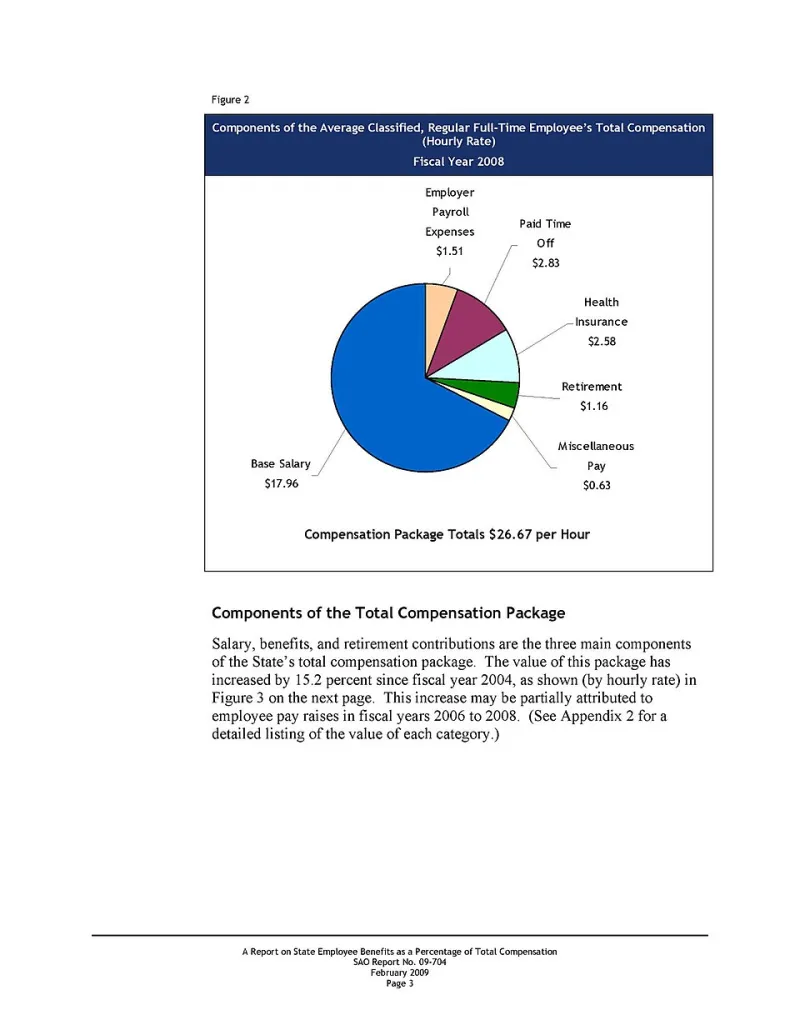
Photo: Texas. Office of the State Auditor; Keel, John, Public domain, via Wikimedia Commons
The Number HR Quotes Is Not the Number That Matters
During onboarding, in job postings, and throughout annual review cycles, HR departments routinely present a "total compensation" figure that bundles your salary together with the estimated value of every benefit your employer provides. The resulting number often sounds impressive — sometimes 30 to 40 percent above your base pay. What most employees never pause to question is how that figure was constructed, and more importantly, how much of it will ever translate into genuine financial progress.
Not all benefits are created equal. Some deliver measurable, compounding value over the course of a career. Others are included in the total compensation calculation primarily because they cost the employer something — not because they meaningfully improve your financial position. Learning to distinguish between the two is one of the most underappreciated financial skills an American worker can develop.
How Employers Calculate "Total Compensation" — And Why It Flatters Them
Employers are not being deceptive when they present inflated-looking benefits values. They are following standard accounting practices. Every dollar your employer contributes toward your health insurance premium counts. So does the employer's share of Social Security and Medicare taxes — costs that are legally mandated and provide you no additional benefit beyond what you would receive regardless of where you work. Paid time off is assigned a dollar value based on your daily wage rate. Even the coffee in the break room can, in certain accounting frameworks, find its way into a benefits summary.
The result is a total compensation number that is technically accurate but practically misleading. When an employer says your $70,000 salary comes with $28,000 in benefits, that $28,000 may include $9,000 in employer payroll taxes, $12,000 in health insurance premiums (much of which covers costs you would face from any employer), and several thousand dollars in perks — gym reimbursements, commuter subsidies, employee assistance programs — that you may rarely or never use.
The benefits that remain after stripping away statutory costs and low-utility perks are often far fewer than the headline figure implies.
Benefits That Genuinely Build Wealth
Some employer-provided benefits have a direct, measurable impact on long-term financial security. These deserve careful attention during both job evaluation and annual enrollment periods.
Employer 401(k) or 403(b) Matching is among the most powerful wealth-building tools available to American workers. A dollar-for-dollar match up to a certain percentage of salary is an immediate 100 percent return on those contributed dollars — a rate no investment can reliably replicate. Workers who fail to contribute enough to capture the full match are, in effect, declining a portion of their compensation.
Health Savings Accounts (HSAs), when paired with a qualifying high-deductible health plan, offer a triple tax advantage: contributions reduce taxable income, growth is tax-free, and withdrawals for qualified medical expenses are not taxed. Unlike Flexible Spending Accounts, HSA balances roll over indefinitely and can be invested. For workers in good health who can afford to let the account grow, an employer-seeded HSA can become a meaningful component of retirement planning.
Pension Plans and Defined Benefit Structures, while increasingly rare in the private sector, represent a form of guaranteed income in retirement that no market downturn can eliminate. Workers fortunate enough to have access to these plans should model their projected benefit carefully before making any career decisions that would forfeit vesting.
Employer Stock Options and Equity Grants can be transformative — but they require careful analysis. Vesting schedules, exercise prices, tax treatment, and the underlying health of the company all affect actual value. Equity that vests over four years at a company whose stock subsequently declines may deliver far less than the grant-date valuation suggested.
Benefits That Sound Better Than They Are
Not every line item in your benefits summary deserves equal enthusiasm.
Employer-Paid Life Insurance is frequently offered as a flat multiple of salary — often one or two times annual pay. For workers with dependents and significant financial obligations, this amount is almost always insufficient. It provides a baseline, but it should not be confused with adequate coverage. The actual wealth-building value of this benefit is limited.
Employee Assistance Programs (EAPs) offer counseling sessions, legal referrals, and wellness resources. These programs have genuine value for workers who use them, but utilization rates are notoriously low — often under 10 percent. Including their employer cost in a total compensation summary overstates their practical worth for the majority of employees.
Gym Memberships and Wellness Stipends, while pleasant, rarely exceed a few hundred dollars annually. When these perks appear prominently in compensation discussions, it is worth asking whether they are substituting for more substantive financial benefits.
Commuter Benefits and Flexible Spending Accounts offer real tax advantages but are limited in scope and, in the case of FSAs, subject to use-it-or-lose-it rules that can erode their value if not managed carefully.
How to Calculate Your Real Compensation
To understand what your benefits package is actually worth, begin by separating your total compensation into three categories.
First, identify the mandatory employer costs — payroll taxes, workers' compensation insurance, and legally required contributions. These are real costs to your employer, but they do not add meaningful value beyond baseline legal protections.
Second, identify the high-value transferable benefits — retirement matching, HSA contributions, and any equity or pension benefits. Assign these their actual dollar value based on what you would realistically receive.
Third, evaluate the discretionary perks honestly. Ask yourself how frequently you use each one and whether its absence would require you to spend your own money to replace it. Only count what you actually use.
The difference between this figure and the number HR presents is your benefits gap — the portion of your stated total compensation that does not translate into real financial progress.
Negotiating for Benefits That Actually Matter
Armed with this analysis, workers are in a stronger position to negotiate. When evaluating a job offer or preparing for a performance review, consider requesting enhancements to the benefits that compound over time rather than accepting an accumulation of low-utility perks.
Ask whether the employer match threshold can be increased. Inquire about HSA contribution seeding. If equity is on the table, ask for clarity on vesting schedules and the company's most recent valuation. These conversations are more likely to move the needle on long-term financial security than negotiating for an additional week of paid time off or a slightly larger wellness stipend.
If your employer's benefits structure is genuinely limited, factor that into salary negotiations. A role offering a $75,000 salary with a strong 401(k) match, employer HSA contributions, and meaningful equity may outperform a $85,000 offer with no retirement match and minimal wealth-building benefits — particularly over a ten- or twenty-year horizon.
The Financial Literacy Gap Behind the Benefits Gap
The reason so many American workers accept HR's total compensation figures without scrutiny is not indifference — it is a lack of tools and context. Benefits summaries are designed to present the employer's investment in the workforce favorably, and they largely succeed. Without a framework for evaluating which components genuinely build wealth, most workers have no basis for comparison.
Developing that framework is not complicated, but it does require intentional effort. Workers who take the time to understand their benefits in depth — who distinguish between what costs their employer money and what actually improves their financial trajectory — are better positioned to make smarter career decisions, negotiate more effectively, and build the kind of long-term financial security that total compensation summaries often promise but rarely deliver on their own.